On her roots & coming full circle
1. You grew up in a small artisan town in Arizona, where your mother would take you and your siblings to peer through gallery windows in the evenings. Now your work will be on a wall for everyone to stop and admire. What does it mean to bring a large-scale public piece back to the Southwest?
I grew up in Sedona, and those evenings spent looking through gallery windows left a lasting impression on me. To return now and create something on such a large public scale, in a place I feel so deeply connected to, feels like a full-circle moment. Contributing something meaningful to that landscape is a dream realized and it’s the same vision I had as a child standing outside those windows. I’m incredibly grateful to Outbound for the opportunity to come back and create work that feels both personal and shared with the community
2. Growing up surrounded by Arizona’s natural landscape clearly shaped your artistic eye. How does the Sedona environment — the red rocks, the light, that specific sense of place — influence what you’re creating for this mural?
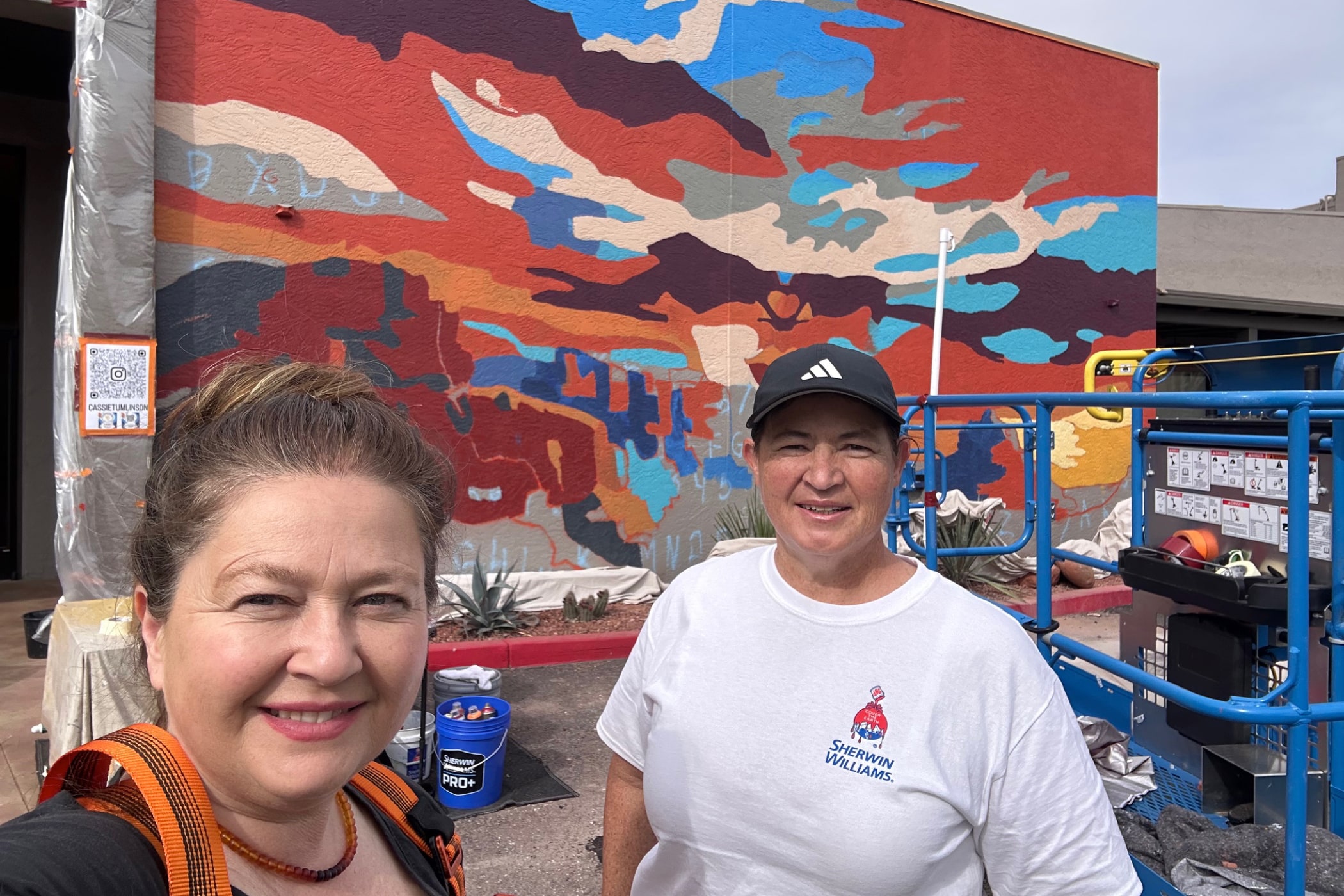
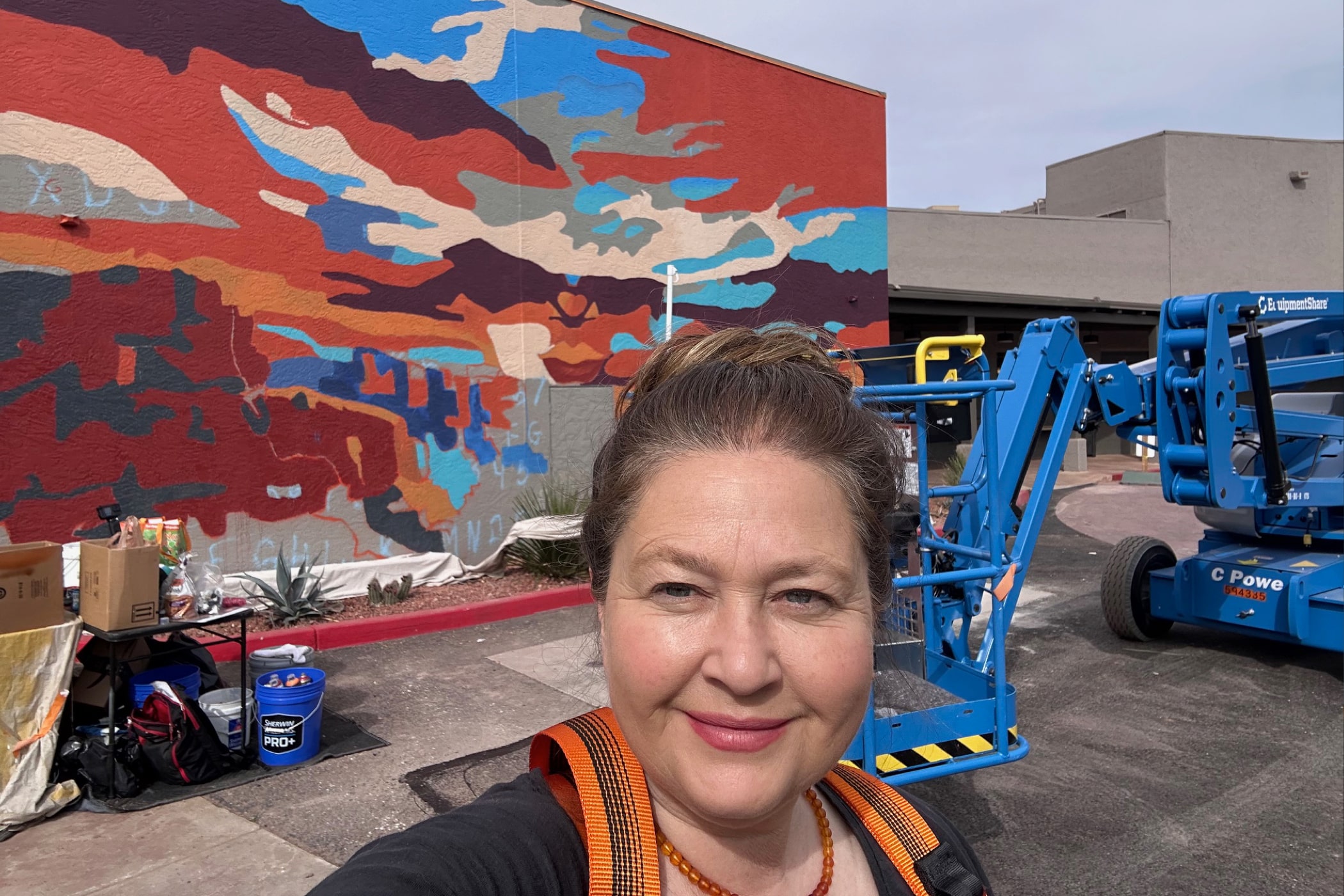
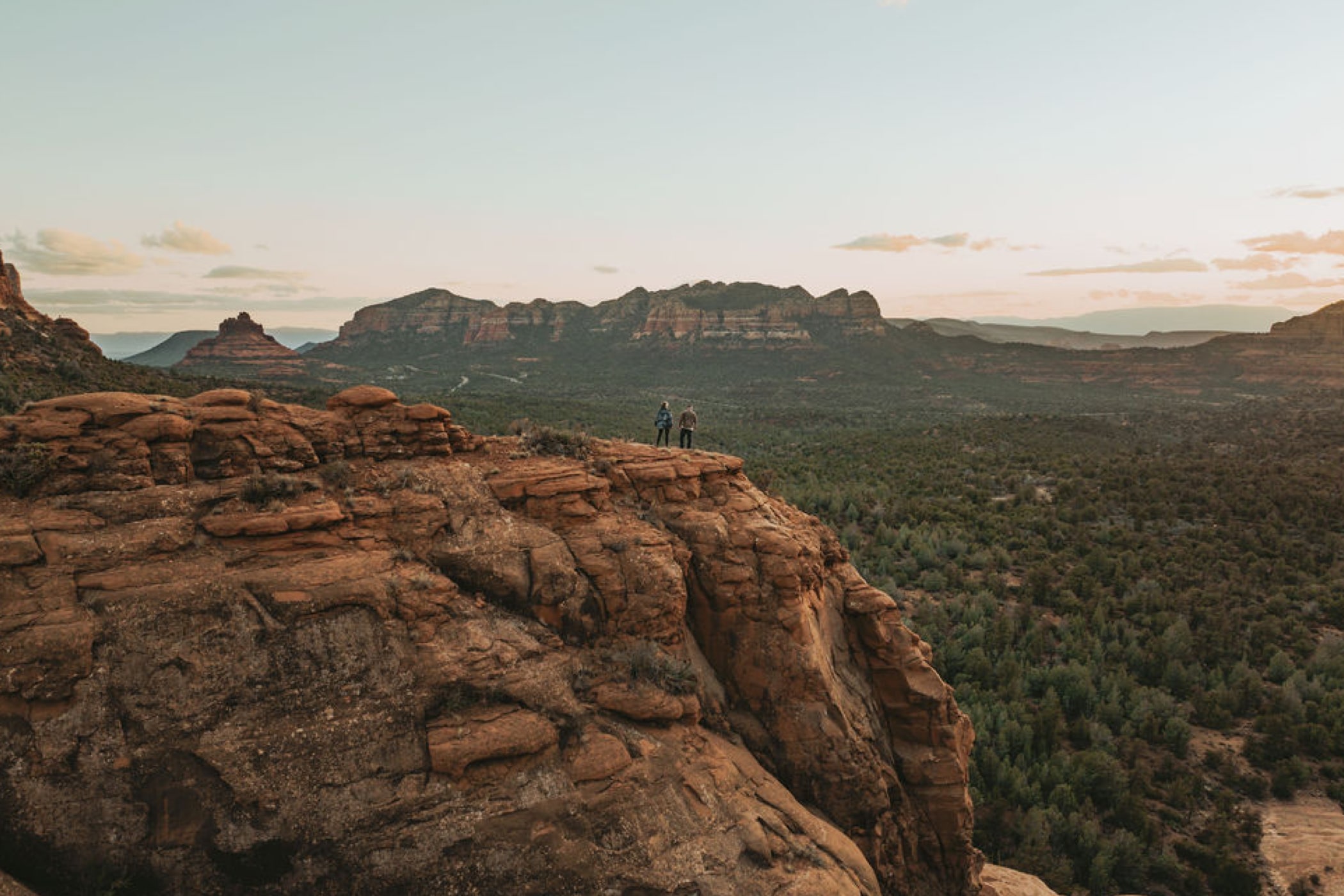
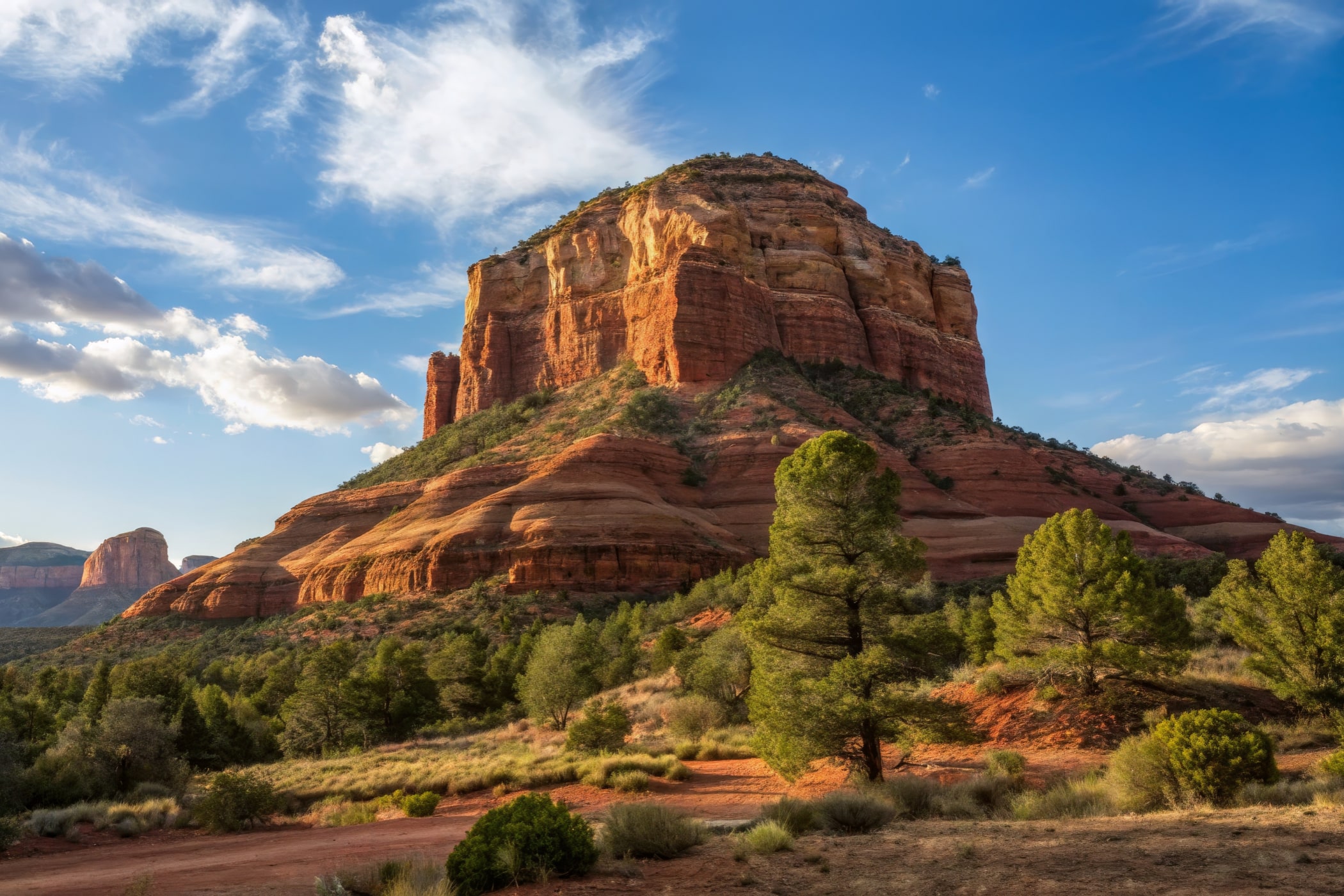
Sedona has had a profound influence on me, so this piece is very personal. The mural is titled “Sedona (Schnebly) Sky,” and it centers around the presence and memory of Sedona Schnebly, one of the town’s early residents, whom Sedona is named after.The work reflects both the physical beauty of the landscape with its the red rocks, the light, the atmosphere and the deep connection people have to this place. I wanted to capture not just what Sedona looks like, but what it feels like: that sense of history, and admiration that draws people in and makes them look. It’s about honoring both the natural environment and the legacy of those who helped shape it.
On her artistic style
3. Your work blends the human form and nature through a surrealist lens — almost dissolving one into the other. How does that philosophy translate to a mural at a place like Outbound Sedona, where guests come specifically to connect with the outdoors?
It translates very naturally. As a figurative artist , I often use the human form metaphorically to express natural phenomena like weather patterns, landscapes, or even local stories and legends. There’s something powerful about merging the human presence with the natural world, especially in a place like Sedona where that connection already feels so strong. In this mural, the figure of Sedona appears and dissolves into the sky, almost like a memory or a presence in the landscape itself. She represents both the beauty of the place and the legacy of the town’s founding family. By blending her form into the environment, I wanted to celebrate both the physical beauty of Sedona and the deeper history behind its name. It’s a way of giving that history the attention it deserves while still inviting viewers to connect with the landscape in a personal, almost dreamlike way.
4. You often incorporate collage and mixed media to deepen the surrealism in your work. Is that part of your approach here, or does working at mural scale change how you think about materials and texture?
Working at mural scale definitely shifts my approach to materials, but the intention stays the same. For this piece, I used a combination of house paint as a base layer and details shading and shaping of the images using spray paint on top. Spray paint is a medium I’m very comfortable with for murals which allows me to create smooth gradients, depth, and a kind of atmospheric, almost three-dimensional quality that really brings the image to life.
On her environmental passion
5. You’re passionate about the environment and use your art to bring awareness to environmental issues. Does this mural carry any of that message, and if so, how do you balance advocacy with the aesthetics of a space?
This mural holds a subtle environmental message. It serves as a reminder of the natural, unspoiled beauty that still exists in Sedona and why it’s worth protecting. The presence of Sedona represented as a figure looking over the landscape suggests a kind of watchfulness, almost like the land is aware of us. There’s a quiet sense that this beauty isn’t permanent unless it’s respected and cared for. It invites appreciation, and from that appreciation, hopefully a sense of responsibility follows.
On public art & her Munich experience
6. You’ve recently become an active part of Munich’s urban art scene, with three large public works there. How has working in public spaces changed your practice compared to studio or gallery work?
Great question. I have a bachelors degree in drawing and painting and up until about 3.5 years ago I painted on canvas in a studio setting. Some of the works were large format but all still on canvas or traditional surfaces. Street art has an excitement and an energy that I think I was missing in my paintings. There’s an edge to working on the street that pushes me creatively in new ways. At the same time, the two practices really inform each other. I bring my traditional training into my public work, while the spontaneity and themes from street art have started to influence my studio pieces. Both are still in the surrealistic space, but they’ve evolved between the street and the studio
7. Murals are inherently democratic — they’re not behind a gallery door. What do you hope a first-time visitor to Outbound Sedona, someone who might not consider themselves an “art person,” takes away when they encounter your mural?
A large scale is hard to ignore and can naturally stop you in your tracks. You don’t need to consider yourself an “art person” to feel its presence or be impacted by it. What I hope is that it creates a moment of curiosity and wonder. Maybe someone starts thinking about how it was made, why certain colors were chosen, or even hidden imagery. Even if they don’t have those questions immediately, I hope the curiosity stays with them long enough that next time they might notice an artwork on a smaller scale or detail in the world around them that they might not have paid attention to before. Ultimately, I hope it makes people more aware of their surroundings and more open to looking at both art and nature with a bit more attention and appreciation.
On her journey as an artist
8. You started selling work straight out of high school, graduated summa cum laude from ASU, ran exhibitions in San Francisco, and now live and paint in Munich. Is there a through-line — a core idea or question — that has guided your work across all of that?
There is definitely a through-line in my work. I keep returning to surrealism as a visual language because it allows me to “talk” about our natural world and larger concepts in a way that feels open-ended. It gives me space to pose questions about why things are the way they are, rather than trying to define them too literally. Another constant is the human form. It appears repeatedly in my work, but more as a metaphor than a literal subject. I use it as a way to connect people to landscape, emotion, and natural forces. Across all the different places I’ve lived and worked, from Arizona to San Francisco to Munich, that combination of surrealism and the figurative has remained the foundation of my practice.
9. You’ve spent years teaching children from difficult backgrounds and supporting youth arts programs. How does working with young people influence the way you think about creating work for public spaces?
Working with children has had a big influence on how I think about public art. When I create for public spaces, I try to consider a wide audience, and that naturally includes children and their curiosity, honesty, and the way they interpret imagery without overthinking it. I like the idea that a mural can operate on different levels at the same time. On the surface, it can be immediate and accessible, especially for younger viewers, while also holding deeper meaning for those who spend more time with it. The openness and excitement children bring to experiencing art is also incredibly contagious. It reminds me not to overcomplicate things and to stay connected to the sense of wonder that first draws people in.
A closing/personal question
10. What’s one thing about this mural — a detail, a moment in the process, a specific image — that you’re most excited for people to discover?
The installation of this mural was a collaborative effort. I worked alongside my partner, Karen, who owns “Painting Queen”, a licensed and bonded residential and commercial repainting company. We’ve known each other since high school and even went through the same art program at ASU, so being able to bring this piece to life together added another layer of meaning to an already very personal project.